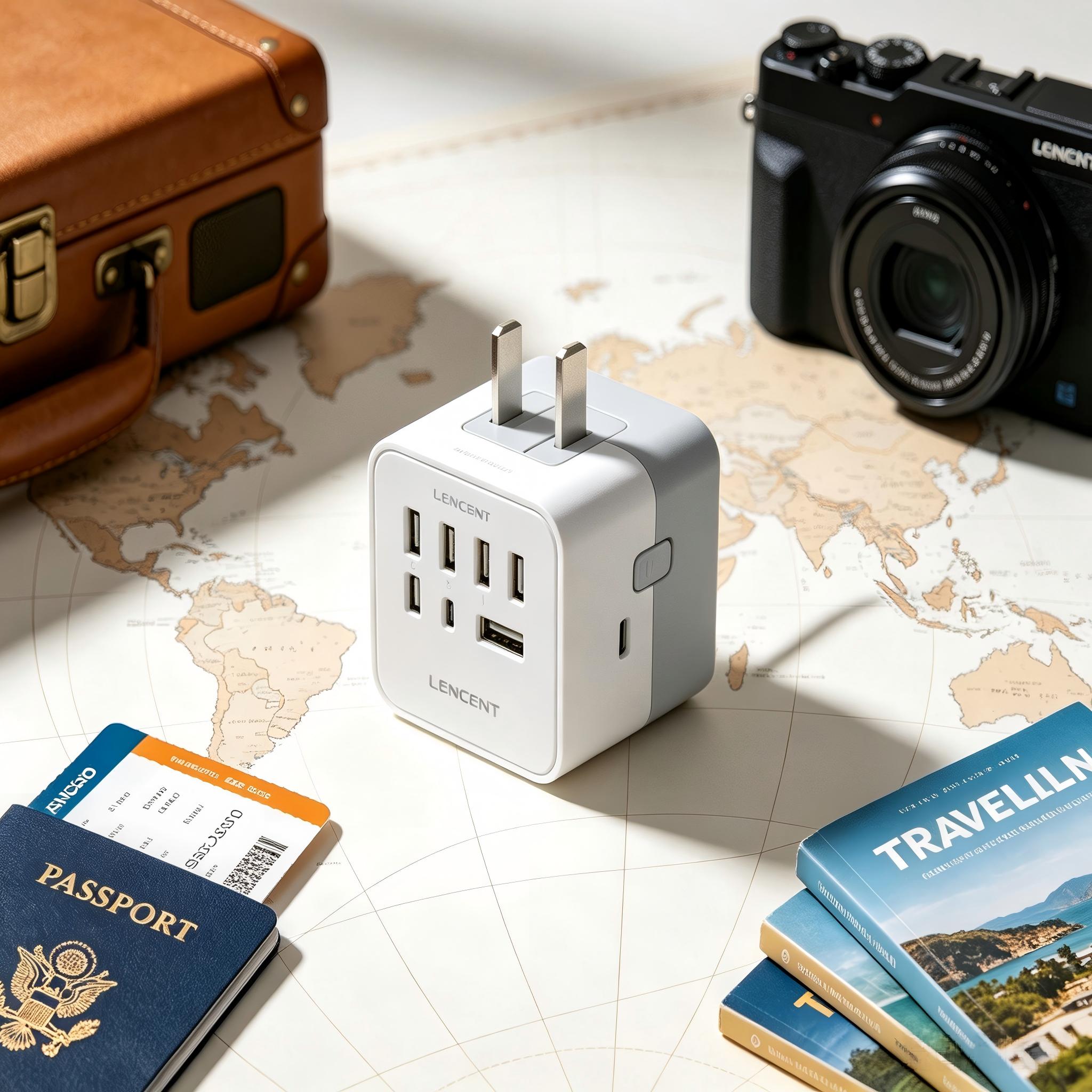
Most travelers have made this common mistake: grabbing a travel adapter before an international trip and assuming it can fix all power issues abroad. Many people mistakenly believe that a travel converter can change voltage, but this misunderstanding can lead to damaged electronics, burnt chargers, or even safety risks during travel. Today, we will clarify the key difference and explain why LENCENT travel adapters do not convert voltage — and why this is actually safer and more suitable for modern travel.
The Core Truth: Travel Adapters Don’t Change Voltage
First of all, it is essential to understand the basic function of a standard travel adapter like the LENCENT universal travel converter. Its only job isplug conversion. It simply changes the shape of your device’s plug to fit different wall sockets in over 200 countries worldwide, including Europe, the UK, Australia, Asia, and North America. It connects your device to the local power outlet but does not raise or lower the local voltage at all.
In short, if you plug a LENCENT travel adapter into a 230V European socket, the output voltage remains 230V. If you use it in a 110V American socket, the voltage stays 110V. It has no built-in voltage transformation components, which is the standard design for most reliable global travel adapters.
Why This Design Is Perfect for Modern Travelers
You may wonder: is it a disadvantage that the adapter cannot convert voltage? The answer is absolutely no. Almost all modern travel electronics, including smartphones, tablets, laptops, wireless earbuds, power banks, and action cameras, are designed with dual-voltage compatibility. They support a universal voltage range of 100V–240V, which covers the standard voltage of nearly all countries around the world.
This means your daily travel devices can work normally with both 110V low voltage and 220V–240V high voltage. For these devices, you only need a LENCENT travel adapter to solve the plug mismatch problem, and voltage conversion is completely unnecessary. Without redundant voltage conversion modules, LENCENT adapters are lighter, more compact, more durable, and less prone to circuit failures during long-term travel use.
When Do You Need a Real Voltage Converter?
Voltage converters are only required for single-voltage high-power appliances that do not support 100V–240V universal voltage. Typical examples include old hair dryers, curling irons, electric kettles, and portable heaters that only support 220V or 110V fixed voltage.
If you bring these single-voltage devices abroad, simply using a travel adapter will cause overheating, circuit burnout, or even safety accidents due to unmatched voltage. In this case, you need a professional voltage transformer instead of an ordinary travel adapter. For daily electronic devices that travelers carry most often, however, a LENCENT plug adapter is fully sufficient and safer.
Safety Advantages of LENCENT Non-Voltage Conversion Adapters
Professional voltage conversion equipment is usually bulky, heavy, and expensive, with complex internal circuits that have higher failure risks. LENCENT travel adapters abandon unnecessary voltage conversion functions and focus on optimizing plug compatibility and charging safety. Equipped with overload, over-current, and short-circuit protection, they can stably and safely charge all universal dual-voltage travel devices.
The simplified and professional design avoids potential safety hazards caused by unstable voltage conversion, making it more reliable for daily travel, business trips, and overseas study use.
Final Travel Tips
To sum up, never confuse a travel plug adapter with a voltage converter. LENCENT universal travel converters are professional plug conversion tools for global travel, which do not convert voltage but perfectly meet the charging needs of 99% of modern travel electronic devices. Before your next overseas trip, simply check the voltage label on your devices — for all 100V–240V dual-voltage gadgets, a portable and reliable LENCENT travel adapter is all you need for hassle-free global charging.